Sovereign finance requires settlement networks that do not break under scale or regulatory pressure. Built on ZKsync zero-knowledge rollup infrastructure, ADI Chain operates as an institutional Layer-2 network designed for direct compliance within the Abu Dhabi Global Market framework. Honestly, most public chains talk about institutional adoption, but ADI Chain is already running high-value production transfers. In this article, we discuss ADI Chain use cases worth your attention.
Build on ADI Chain with IdeaSoft
From stablecoin infrastructure and RWA tokenization to AI agents and enterprise applications, IdeaSoft helps businesses design and build solutions for the ADI ecosystem.
Table of contents:
What is ADI Chain?
Built to serve as sovereign digital infrastructure across the Middle East, Africa, and Asia, ADI Chain operates within the Abu Dhabi Global Market (ADGM) legal framework. It provides institutional market participants with explicit regulatory clarity.
| Technical Benchmark | ADI Chain Layer-2 | Public Ethereum Layer-1 | Legacy Interbank Rails (SWIFT) |
| Execution Architecture | ZKsync Airbender / Atlas Zero-Knowledge Rollup | Proof-of-Stake Consensus Layer | Centralized Messaging & Clearing Houses |
| Transaction Throughput | 8,000+ Transactions Per Second (TPS) | ~15 – 30 Transactions Per Second | Batch processing windows |
| Settlement Finality | 1–2s transaction inclusion / <60min full ZK proof to Ethereum | ~12 – 15 minutes (2 consensus epochs) | T+1 to T+5 business days |
| Operational Execution Fee | ~$0.02 fee for simple transfers; ~$0.06–$0.08 for ERC-20 transfers (Paid in ADI utility token) | Variable ($0.50 to >$20.00 depending on congestion) | 2.5% – 6.0% wire surcharges & foreign exchange spreads |
| Gas Utility Mechanics | Mandatory $ADI burn for every state transition | Dynamic base fee burning in ETH | Fiat handling fees and correspondent banking spreads |
| Regulatory Framework | Native ADGM compliance; CBUAE DDSC approval | Ad-hoc compliance tools | Manual KYC/AML clearing procedures |
Architecturally, ADI Chain uses ZKsync’s zero-knowledge rollup technology, incorporating the Airbender and Atlas prover systems to deliver high-throughput, deterministic execution. The technical specifications enable the network to sustain transaction throughputs exceeding 8,000 transactions per second (TPS), achieving soft confirmations within 0.2 seconds and deterministic finality within 2.0 seconds. Network execution fees are normalized at approximately $0.01 per transaction, settled natively in the network’s utility token, $ADI.
The economic architecture of ADI Chain creates a direct link between institutional ledger activity and token demand dynamics. Every state mutation, treasury settlement, cross-border remittance, and smart contract invocation on the chain mandates the consumption of ADI to cover operational gas fees.
ADI Chain Use Cases
| Deployment Sector | Primary Function | Regulatory / Institutional Status | Performance Benchmark / Metric | Key Ecosystem Partners |
| DDSC Stablecoin | Sovereign Treasury Settlement & Commercial Payments | CBUAE Licensed under Payment Token Regulation; VARA NOC | >AED 150M total volume; AED 110M single treasury transfer | IHC, First Abu Dhabi Bank (FAB), Sirius Holding |
| Predictstreet | On-Chain Derivatives & Capital Allocation | Production Mainnet Deployment (RPC Verified) | ~$254M USDC.e volume; ~790k matched orders | ADI Foundation, Independent DeFi Developers |
| M-Pesa Integration | Emerging Market Remittances & Regional Trade Settlement | Strategic Integration / Development Phase | Target reach of 60M+ users across 8 African countries | M-Pesa Africa, AfCFTA Secretariat |
| ERC-8004 AI Identity | Autonomous Agent Registries & M2M Micro-Payments | Mainnet Registries Deployed; Frontier Stage | Immutable Identity, Reputation & Validation registries | IDA Platform, Eros Innovation (EROSADI), TravAI |
| RWA Tokenization | Institutional Asset Digitization & NAV Tracking | Infrastructure Integrated; Active Partner Pilots | Canonical Oracle & Proof of Reserve feeds live | Chainlink, BNY, Finstreet, Brickken, ZIGChain |
| Healthcare Audit | Claims Adjudication & Fraud Mitigation | Enterprise Pilot Deployment | Immutable claim hashing & audit trails | Apeiro, ADI Enterprise Division |
So, now let’s discuss all the ADI Chain use cases in detail.
DDSC Stablecoin Framework: Sovereign Payment Infrastructure
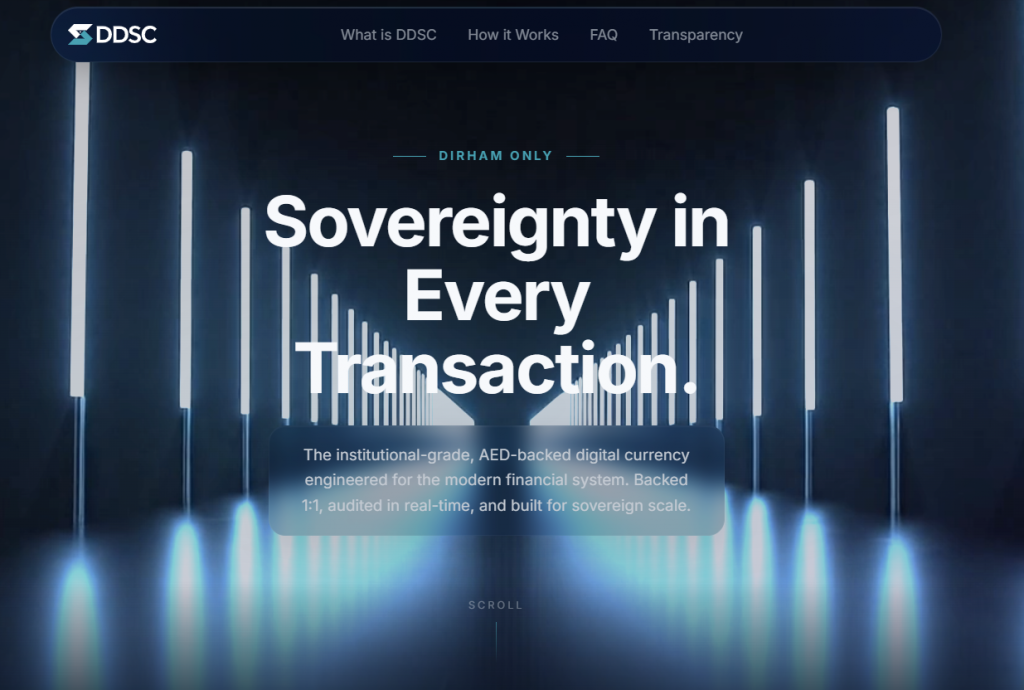
The core component of ADI Chain’s financial settlement layer is the Digital Dirham Stablecoin (DDSC), an institutional-grade, 1:1 UAE Dirham-backed digital currency. The Central Bank of the United Arab Emirates (CBUAE) issued it under the Payment Token Services Regulation. DDSC establishes a compliant alternative to uncollateralized or privately issued US-dollar-denominated retail stablecoins.
DDSC is operated by a strategic consortium comprising:
- International Holding Company (IHC) — a major Abu Dhabi-based investment holding company with a diversified portfolio spanning technology, healthcare, real estate, food and agriculture, and financial services.
- First Abu Dhabi Bank (FAB) — the UAE’s largest banking institution, holding over $330 billion in assets and managing approximately 33% of the domestic banking market.
- Sirius International Holding — an Abu Dhabi-based investment and technology-focused holding company involved in developing and supporting digital and emerging-technology initiatives.
- ADI Foundation — the organization responsible for providing the Layer-2 blockchain infrastructure supporting DDSC.
The token’s reserve model mandates 1:1 AED backing, with full reserves held in ring-fenced accounts across licensed custodians. They are subject to real-time third-party attestations and public monthly reserve audits.
The institutional operational capability of DDSC on the ADI Chain was formally validated in May 2026, when IHC executed a single corporate treasury transfer of AED 110 million (approximately $30 million USD). This transaction represented the largest disclosed institutional stablecoin transfer in the United Arab Emirates. It moved the underlying chain from technical validation into production-grade treasury management.
By July 2026, cumulative transaction volume for DDSC on ADI Chain exceeded AED 150 million, demonstrating sustained network stability and high-value throughput. Following this institutional phase, the CBUAE issued a formal No Objection Certificate (NOC). It authorized the distribution of DDSC across exchange platforms regulated by Dubai’s Virtual Assets Regulatory Authority (VARA). This milestone expanded DDSC’s deployment from interbank treasury settlement into commercial merchant payments, supply chain invoicing, and consumer-facing digital asset transactions.
Every DDSC payment, transfer, and redemption resolves natively on ADI Chain. This accelerates state execution frequency, creating continuous operational burn and transaction-fee demand for ADI.
Predictstreet Metrics: High-Throughput Financial Application

Beyond sovereign payment infrastructure, ADI Chain hosts high-density financial applications that demand deterministic execution and low transaction latency. Predictstreet, an on-chain prediction market and capital allocation platform operating on ADI Chain, represents the network’s highest-volume financial deployment.
On-chain analysis of RPC node logs between May 30, 2026, and August 14, 2026, confirms that Predictstreet processed approximately $254 million in cumulative execution volume, denominated in bridged USD Coin (USDC.e). It facilitated roughly 790,000 individual order matches. This execution density demonstrates ADI Chain’s capacity to support sustained transaction processing without encountering state congestion or gas fee inflation.
An architectural detail of this deployment concerns off-chain analytics visibility. The market analytics platform, DefiLlama, underreported Predictstreet’s operational metrics because of an event-parsing mismatch in its indexer adapters. The deployed smart contract emitted event logs containing 8 data words, whereas legacy analytics adapters were configured to decode standard 7-word event structures. As a result, off-chain indexers failed to process a substantial portion of valid contract state transitions. Direct extraction and decoding of raw event logs from ADI Chain RPC endpoints establish the $254 million volume figure as the authoritative measure of platform liquidity and transaction activity.
Predictstreet’s operational history illustrates the structural role of zero-knowledge rollup infrastructure in supporting complex derivative engines. By executing 790,000 matching events on ADI Chain at sub-cent transaction costs, the platform demonstrates that high-frequency capital allocation models can operate on transparent ledger infrastructure.
M-Pesa Africa Partnership: Cross-Border Corridor Realignment and Emerging Market Scale

A core strategic directive of the ADI Foundation is establishing sovereign digital payment corridors across emerging economies in the Middle East, Africa, and Asia. Traditional cross-border remittance and trade settlement channels in these regions remain constrained by:
- High correspondent banking surcharges
- Settlement latencies ranging from three to five business days
- Liquidity fragmentation across local currencies
To deploy scalable solutions in these markets, the ADI Foundation established a strategic partnership with M-Pesa Africa, the continent’s largest mobile money service provider. It operates across 8 countries with a user base exceeding 60 million active accounts. The initiative focuses on integrating low-cost, on-chain settlement mechanisms directly into M-Pesa’s existing financial infrastructure via ADI Chain.
By routing cross-border payments over ADI Chain using regulated payment assets such as DDSC, transaction processing bypasses legacy correspondent clearing banks. This aligns with the operational goals of the African Continental Free Trade Area (AfCFTA) Secretariat, which aims to build integrated digital market infrastructure across participating nations.
The economic impact of this integration reaches beyond transaction speed. Settling trade flows between Gulf Cooperation Council (GCC) entities and African commercial hubs on-chain reduces cross-border transfer costs from retail banking averages of 6–10% to sub-fractional transaction fees on ADI Chain. Concurrently, settlement timelines change from multi-day clearing cycles to near-instantaneous finality. This multi-regional connectivity positions ADI Chain as a central clearing layer for South-South commercial trade.
EROSADI and TravAI: Autonomous AI-Agent Economies and ERC-8004
As artificial intelligence systems have moved into autonomous operational agents, a dedicated identity, validation, and micro-payment framework is required. Autonomous agents operating across organizational boundaries must possess:
- Cryptographically verifiable identities
- Verifiable operational records
- Programmatically accessible payment rails
ADI Chain addresses these requirements through the mainnet deployment of the ERC-8004 standard, establishing foundational registries for autonomous agent operations. Operating as early-stage, frontier infrastructure, ERC-8004 implements three on-chain primitives:
- Identity Registries. They establish standardized, cryptographically verifiable identifiers (did:adi:agent:*) for autonomous software agents, enabling decentralized discovery and authorization mapping.
- Reputation Registries. They store immutable operational histories and interaction attestations, allowing prospective counterparties to programmatically assess agent reliability.
- Validation Registries. They verify execution proofs and contract completion criteria before releasing escrowed settlement funds.
This protocol stack is integrated into the Institutional Decentralized Authority (IDA) identity framework on ADI Chain. Compliant with W3C Decentralized Identifier (DID) specifications and aligned with the European Union AI Act (2024/1689), IDA supports zero-knowledge credential verification (via BBS+ signatures) and programmatic authorization structures. Through Invocation-Bound Capability Tokens (IBCT), human supervisors can delegate limited operational authority to autonomous agents. You can enforce strict spending limits and execution boundaries.
Early-stage applications using this agentic infrastructure on ADI Chain include:
- EROSADI. Built in partnership with Eros Innovation, EROSADI functions as a sovereign cultural AI operating system. It incorporates a programmable Rights Registry that digitizes intellectual property provenance. This allows autonomous agents to query verified media assets, confirm usage licensing, and execute automated micro-royalty payments to rightsholders via ADI Chain payment rails.
- TravAI. Developed through a collaboration involving NEAR Protocol, Datrics, and the ADI Chain team, TravAI automates enterprise travel procurement. Autonomous agents search global travel inventories, negotiate vendor pricing, and settle multi-party bookings using DDSC and ADI smart contract rails.
The convergence of ERC-8004 identity frameworks with CBUAE-regulated payment tokens creates infrastructure for machine-to-machine (M2M) economies. Software agents can autonomously purchase compute capacity, access data streams, and settle commercial services in regulated local currency units.
Turn ADI Chain Infrastructure Into Real-World Applications
We help businesses build scalable ADI Chain solutions across payments, tokenization, AI infrastructure, and other institutional use cases.
Deep Enterprise Pipeline: Tokenization, Healthcare, and Climate Assets
The enterprise pipeline of ADI Chain encompasses several real-world tokenization, auditing, and environmental pilots currently moving through development and staged deployment.
Real-World Asset (RWA) Tokenization
In March 2026, the ADI Foundation entered into an official partnership with Chainlink, selecting the network as the canonical oracle and cross-chain infrastructure provider for ADI Chain across the Middle East, Africa, and Asia. Under this arrangement, Chainlink’s Decentralized Oracle Networks (DONs) supply automated price feeds, Proof of Reserve (PoR) verification for stablecoins, and off-chain Net Asset Value (NAV) data feeds for tokenized private equity, debt instruments, and investment funds.
Furthermore, the integration of Chainlink’s Cross-Chain Interoperability Protocol (CCIP) enables secure cross-chain movement of tokenized assets between ADI Chain and external public or private ledgers. This oracle architecture supports asset tokenization deployments built in collaboration with enterprise partners such as Brickken and ZIGChain. They allow institutional real estate, fixed-income products, and corporate securities to be fractionalized and settled on-chain against DDSC liquidity pools.
Healthcare Claims Verification
In healthcare infrastructure, the ADI Foundation has partnered with Apeiro to deploy a blockchain-based audit layer for medical claims verification. Healthcare claims processing is frequently affected by billing discrepancies, administrative delays, and fraudulent submissions.
By hashing patient claims metadata, diagnostic records, and provider approvals onto ADI Chain, Apeiro creates an immutable audit trail. This prevents unauthorized claims modifications, enables automated smart contract adjudication, and reduces claim settlement cycles.
Climate Infrastructure and Environmental Assets
In alignment with regional environmental initiatives, ADI Chain is conducting pilots focused on carbon credit tokenization and climate asset tracking across East Africa. Using the ledger’s audit capabilities and low execution costs, the framework tracks the generation, validation, and retirement of verified carbon units (VCUs). By recording environmental asset metadata directly on-chain, the platform mitigates double-counting risks and provides corporate buyers with verifiable provenance for ESG compliance reporting.
Enterprise Security Architecture and Governance: Hypernative Partnership
Institutional participation in public distributed ledgers requires continuous mitigation of operational risks, smart contract vulnerabilities, and bridge security threats. To address these requirements, ADI Chain incorporates real-time security monitoring directly into its operational layer through an integration with Hypernative.
The Hypernative integration provides continuous monitoring and automated defensive capabilities across all:
- Cross-chain bridge contracts
- Protocol administrative wallets
- System state transitions
Using transaction simulation and heuristic threat detection, the security engine identifies anomalous call parameters, flash-loan vectors, or unauthorized administrative maneuvers before block inclusion.
If a potential security breach is identified, automated response mechanisms can trigger circuit breakers, temporarily pausing compromised bridge channels or isolating affected smart contract functions. This continuous security architecture provides institutional custodians, corporate treasuries, and sovereign entities with the operational safeguards required to execute high-value financial transfers on-chain.
To complement protocol-level security, the ADI Foundation has established institutional digital asset custody infrastructure. In May 2026, the ADI Foundation partnered with BNY (Bank of New York Mellon) and Finstreet to launch regulated digital asset custody services in Abu Dhabi. This infrastructure supports institutional asset servicing, providing tier-1 custodial safeguards for reserve assets and tokenized instruments deployed on ADI Chain.
Summary
ADI Chain demonstrates an institutional framework for zero-knowledge Layer-2 blockchain networks. Key use cases of ADI Chain:
- The successful deployment of the CBUAE-licensed Digital Dirham Stablecoin (DDSC) proves that sovereign-backed digital fiat tokens can operate effectively on public zero-knowledge infrastructure.
- The execution of the AED 110 million IHC treasury transfer, combined with the CBUAE No Objection Certificate for VARA-regulated exchange distribution, demonstrates a viable transition path from wholesale interbank clearing to commercial payment adoption.
- Routing cross-border payments through mobile ecosystems such as M-Pesa Africa positions ADI Chain to capture high-volume remittance flows across key emerging market corridors.
- The mainnet integration of ERC-8004 agent registries establishes infrastructure for next-generation machine economies, allowing autonomous AI agents to verify identity, establish trust, and execute real-time micro-settlements in regulated digital currencies.
Because every payment rail, prediction engine, healthcare registry, and agent interaction requires gas execution in ADI, the growth of these enterprise ADI Chain use cases establishes an activity-driven utility model for the native token.
Build Your Next Institutional Solution on ADI Chain
From regulated payment rails to tokenized assets and autonomous AI agents, IdeaSoft provides the blockchain engineering expertise to bring ADI Chain use cases to life.