Institutional adoption of blockchain infrastructure hinges on one question: can a network deliver Ethereum-grade security without sacrificing compliance? ADI Chain answers this with a zkSync-powered Layer 2 architecture purpose-built for regulated entities — and the ADI token sits at the center of it, powering gas fees, settlement, and staking across the ecosystem.
Our guide breaks down everything you need to know about the ADI token model:
- Its fixed 999,999,999 supply and vesting schedule
- Canonical bridge contracts that move assets between Ethereum and ADI Chain
- Account abstraction and paymaster infrastructure enabling gasless transactions
- MiCA compliance framework positioning ADI Chain for institutional-grade adoption in the EU and UAE
So, let’s start!
Build on ADI Chain With Confidence
Partner with IdeaSoft to develop secure, scalable applications, tokenization platforms, and financial infrastructure on ADI Chain.
Table of contents:
- What Is ADI Chain?
- ADI Tokenomics: Supply, Allocation, and Vesting Schedule
- Canonical Bridge Architecture: Contracts and Cross-Chain Mechanics
- How Does Bridging Work on ADI Chain?
- ADI Chain System Architecture: Execution Engine and Resource Accounting
- Regulatory Compliance and Ecosystem Adoption of ADI Chain
- Conclusion
What Is ADI Chain?
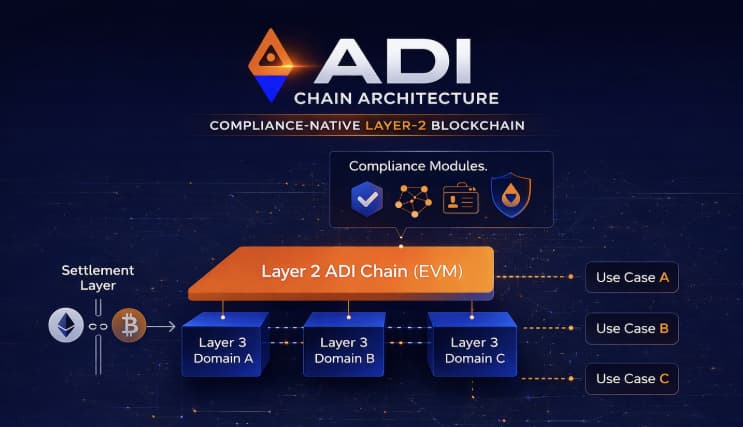
ADI Chain is an institutional Ethereum Layer 2 scaling solution built for organizations that need both cryptographic privacy and regulatory alignment. The network runs on the zkSync zkStack framework paired with the Airbender prover to generate zero-knowledge proof verifications.
This architecture is designed to solve a long-standing problem: sovereign entities and regulated institutions have historically been slow to adopt public blockchains because legacy compliance systems remain fragmented. ADI Chain addresses this by offering modular Layer 3 options — customized compliance domains that stay anchored to ADI Chain’s L1-secured base layer.
ADI as the Native Gas Token
The ADI token is the base gas asset of the entire ecosystem, made possible by zkStack’s custom gas token functionality. It lets the network bypass ETH for fee payments — a practical design choice for enterprise balance sheets. ADI is used to pay gas on both the L2 chain and any child L3 networks, and it also serves as the primary settlement currency between developers, validators, and enterprise participants.
Token holders can additionally lock ADI in treasury-backed staking pools to earn yield. Because this yield is distributed from existing treasury reserves rather than newly minted tokens, the staking model avoids supply debasement.
ADI Tokenomics: Supply, Allocation, and Vesting Schedule
The ADI genesis event minted a fixed total supply of 999,999,999 ADI. The distribution structure was designed around long-term project viability rather than short-term liquidity.
| Allocation Group | Share of Total | Token Supply | Cliff Duration | Vesting Period | Launch Unlock |
| Community Fund | 35.00% | 349,999,999.65 | None | 72 Months | 1.39% |
| Treasury Reserves | 25.00% | 249,999,999.75 | None | 108 Months | 5.00% |
| Private Investors | 12.00% | 119,999,999.88 | 12 Months | 72 Months | 0.00% |
| Partnerships | 10.00% | 99,999,999.90 | 12 Months | 72 Months | 0.00% |
| Team | 10.00% | 99,999,999.90 | 12 Months | 72 Months | 0.00% |
| Incentivization | 4.00% | 39,999,999.96 | None | Immediate | 100.00% |
| Liquidity | 4.00% | 39,999,999.96 | None | Immediate | 100.00% |
Key vesting terms:
- The Community Fund (35% of supply) unlocks linearly over 72 months, with 1.39% available at token generation.
- Treasury Reserves (25%) vest over the longest window — 108 months — with a 5% launch unlock.
- Private Investors, Partnerships, and Team allocations (32% combined) are locked behind a 12-month cliff, followed by 72 months of monthly linear unlocks.
- During the network’s first year, active unlock events for eligible pools occur on the 9th day of each month, smoothing out sudden shifts in circulating supply.
Because roughly 80% of team and investor tokens remain in locked smart contracts for multiple years, near-term sell pressure from insiders is structurally limited.
ADI Price History and Circulating Supply
Circulating supply currently sits at approximately 125,331,789 ADI. Historical price action shows a low of $0.9754 on December 10, 2025, and a high of $8.72 on June 29, 2026, reflecting the gradual release of tokens relative to real transaction demand on the network.
Canonical Bridge Architecture: Contracts and Cross-Chain Mechanics
ADI Chain moves assets between Ethereum and its L2 network through a canonical bridge, which inherits Ethereum’s mainnet security rather than relying on third-party bridge infrastructure. Every cross-chain transfer is validated through zero-knowledge proofs verified directly on L1 contracts.
| Contract | Layer | Address | Function |
| Base Token (ERC20) | L1 | 0x8b1484d57abbe239bb280661377363b03c89caea | Native token representation on Ethereum |
| Diamond Proxy | L1 | 0x0583ef2b6416cb7b287406438b940e4d99680c5b | Main entry point for L1 state updates |
| Governance | L1 | 0x7200b8b09950b27bdf785c4c8e592c4ab141e5f7 | Future on-chain governance voting |
| L2 Base Token | L2 | 0x000000000000000000000000000000000000800A | System contract for ADI on L2 |
| L2 Asset Router | L2 | 0x0000000000000000000000000000000000010003 | Entry point for non-native asset routing |
| L2 Native Token Vault | L2 | 0x0000000000000000000000000000000000010004 | Deploys standard contracts for bridged ERC20s |
How Does Bridging Work on ADI Chain?
Want to bridge native ADI? The protocol uses requestL2TransactionDirect, which locks the L1 ERC20 version of ADI in the L1 Native Token Vault and updates its chain balance registry to prevent multi-chain double-spending.
Want to bridge standard ERC20 tokens? This requires the requestL2TransactionTwoBridges interface and two separate approvals:
- One authorizing the bridge to spend the ERC20 token
- One authorizing it to spend ADI to cover L2 gas
The L1 Asset Router then routes the gas asset to the Native Token Vault and the ERC20 asset to its own repository. If a token is bridged for the first time, the L2 Native Token Vault deploys a new contract on the destination chain using a deterministic CREATE2 call.
Withdrawal Pipeline (L2 → L1):
- Burn & register. The user calls withdraw on the L2 Base Token contract, burning ADI on L2 and registering an exit message with the L1 Messenger.
- Batch Commitment. Transaction data is batched with other block transitions and committed to Ethereum.
- Proof Generation. The prover generates a cryptographic proof confirming correct execution of every transaction in the block.
- Execution & Claim. The verified Merkle root is stored on L1, and the user submits a claim to the L1 Nullifier contract, which checks the proof and blocks double-claiming.
Integrating with ADI Chain’s canonical bridge? IdeaSoft’s engineers specialize in cross-chain infrastructure, including L1↔L2 bridge integrations, custom gas token implementations, and Native Token Vault deployments. We can help your team implement requestL2TransactionDirect and requestL2TransactionTwoBridges flows correctly the first time.
Turn ADI Chain Infrastructure Into Your Next Product
Contact us to design and develop scalable blockchain solutions tailored to your business and compliance requirements.
ADI Chain System Architecture: Execution Engine and Resource Accounting
ADI Chain’s execution engine uses a specialized bootloader to handle system initialization, transaction parsing, and result storage. Configurable parameters include:
- ONLY_SIMULATE. It skips standard validation for call simulations during node queries
- IS_PROVING_ENVIRONMENT. It bypasses specific checks during sequencing to optimize performance
- AA_ENABLED. It enables native account abstraction support
- SPECIAL_ADDRESS_SPACE_BOUND. It reserves address space for system contracts
To keep fees predictable, the protocol uses double resource accounting, billing separately for computation and physical data storage, since zk-rollups must account for proving costs in addition to execution. Two runtime environments support this:
- Forward Running Mode. It runs on the sequencer’s standard OS, using default memory allocation and skipping some verification steps (e.g., Merkle proofs for storage reads) to prioritize speed.
- Proving Running Mode. It runs on a bare RISC-V platform without an OS, requiring manual memory management and deterministic execution so all outputs remain mathematically provable.
Running an Independent Follower Node
The ADI Stack Setup repository provides a one-command deployment for a read-only follower node, made up of two containers:
- external_node — replays L2 blocks from the main node to maintain local state
- proof-sync — periodically pulls proving artifacts from Azure Blob Storage to verify state transitions
Running a follower node requires Docker and an archive-capable L1 RPC endpoint. Follower nodes do not generate proofs or participate in sequencing themselves. However, they can accept signed transactions via eth_sendRawTransaction and forward them to the sequencer through the configured general_main_node_rpc_url. This allows them to support transaction submission while still serving primarily as independent nodes for verification and private data queries.
Account Abstraction and Paymaster Security Audit
ADI Chain supports ERC-4337 account abstraction, though it does not ship pre-configured, audited paymaster contracts by default. Users can connect smart accounts such as ZeroDev Kernel v3.1, while operators must deploy their own paymaster contracts to sponsor gasless transactions.
Hacken audited the GaslessPaymaster.sol contract (commit 3ca0338) and flagged one key operational risk. The contract used a pre-funded deposit model where sponsored user operations draw from a shared vault balance at the EntryPoint contract, but it lacked an on-chain automated pause trigger for when that balance runs low. If the deposit is drained, gasless transactions fail immediately, creating a potential bottleneck for enterprise dApps.
Hacken’s recommended mitigations included off-chain monitoring or automated emergency actions triggered by unusual transaction volume, large minting events, or changes to contract ownership privileges. ADI Chain resolved that issue.
Regulatory Compliance and Ecosystem Adoption of ADI Chain
Here, we see 3 main points to highlight:
- UAE Dirham Stablecoin Integration. ADI Chain is built to host a regulated stablecoin pegged to the UAE Dirham, issued through a consortium including IHC, First Abu Dhabi Bank, and ADQ. Every stablecoin transfer requires ADI for gas, directly tying token demand to real commercial trade volume.
- MiCA and Travel Rule Compliance. The ADI DLT Foundation has filed MiCA whitepapers with the Central Bank of Ireland to establish regulatory standing in the EU. Structurally, the ADI Foundation operates as infrastructure only. It is not a Virtual Asset Service Provider and does not custody funds or execute trades. Instead, individual L3 operators are responsible for their own FATF Travel Rule compliance, including identifying transaction originators and beneficiaries on their networks.
- Governance Status. At launch, on-chain governance remains inactive. Protocol upgrades and parameter changes are currently managed through chain admins and a validator timelock, with decentralized voting activating only after governance contracts are audited and deployed, and documentation is filed with the Abu Dhabi Global Market Registrar.
Conclusion
The economic design of the ADI token model balances predictable enterprise utility with a fixed, non-inflationary token supply. By using ADI as a gas asset across Layer 2 and Layer 3 environments, the network builds structural demand tied to institutional transactions. This demand is supported by major enterprise applications, such as the upcoming UAE Dirham stablecoin rail.
Still, the network’s long-term success relies on real enterprise adoption. The monthly vesting schedule and lockups mitigate sudden sell pressure, keeping token circulation aligned with active usage. Independent verification through external follow nodes and rigorous compliance filings under MiCA indicate a strong commitment to regulatory standards.
In our view, the project’s ability to maintain high transactional volumes on Layer 3 networks while securing gas payments in the native token will dictate its long-term financial path.
Develop Your ADI Chain Solution
Get expert support for building compliant Web3 products, smart contracts, tokenized assets, and enterprise blockchain solutions on ADI Chain.