The blockchain market is best understood by comparing Ethereum, the preeminent decentralized Layer-1 smart contract platform, with ADI Chain, an institutional-grade Layer-2 zero-knowledge rollup built on the ZKsync zkOS stack and secured directly by Ethereum consensus.
Ethereum was designed with a philosophy of permissionless execution, global decentralization, and credible neutrality. Its primary objective is to serve as a trustless base layer where smart contracts execute deterministically without central oversight. However, this absolute neutrality presents challenges for sovereign states, central banks, and regulated financial institutions, which operate under strict requirements for transaction monitoring, identity verification, and jurisdictional boundaries.
Conversely, ADI Chain, developed by the Abu Dhabi-based ADI Foundation and backed by Sirius International Holding (the digital arm of the International Holding Company), is built to bridge the gap between legacy financial infrastructure and public ledger security. Operating as a modular scaling layer, ADI Chain combines the economic security of Ethereum with customizable, policy-aligned compliance engines.
Build Securely on ADI Chain
Need to integrate ADI Chain into your product? We can help with smart contract development, L2 integrations, wallet infrastructure, and custom blockchain solutions.
Table of contents:
- ADI Chain vs Ethereum Comparison
- ADI vs ETH Blockchain: Consensus, Execution, and State Machine Architectures
- ADI Chain vs Ethereum L2: Resource Management and Accounting Models
- Difference Between ADI Chain and Ethereum: Bridge Infrastructure and Security Risk Vectors
- ADI vs ETH Blockchain: Developer Ecosystem, Middleware, and Wallet Infrastructure
- ADI Chain vs Ethereum: Real-World Case Studies and Stablecoin Ecosystems
- ADI Chain vs ETH: Tokenomics and Monetary Design
- Summary on Difference Between ADI Chain and Ethereum
ADI Chain vs Ethereum Comparison
| Feature Dimension | Ethereum (Layer-1) | ADI Chain (Layer-2 Rollup) |
| Consensus Mechanics | Proof-of-Stake (PoS via Gasper) | Inherited L1 Security via Validity Proofs |
| Prover System | None (On-chain execution) | Airbender STARK-to-SNARK |
| Client Software Architecture | Dual Client (e.g., Geth/Lighthouse) | external_node + proof-sync sidecars |
| Max Theoretical TPS | ~50 TPS | ~10,000 TPS |
| Operational Block Time | ~12 – 15 Seconds | ~1 Second |
| Ecosystem Status | Fully Decentralized L1 Base Layer | Stage 0 Rollup (L2BEAT classification) |
| Gas Pricing Model | Single asset fee market (EIP-1559) | Double Resource: Ergs & Native cycles |
| Gas Asset Integration | Ether ($ETH) | $ADI (Custom Gas Token integration) |
| Account Abstraction (AA) | Optional (ERC-4337 overlay) | Native AA (Kernel smart accounts) |
| RPC Limitations | Standard EVM debugger tools | safe mode unsupported (debug_trace absent) |
| Regulatory Alignment | Global Censorship-Resistant | Local L3 Compliance Domains (CBUAE, VARA) |
| Governance Posture | Community-led social consensus | Dormant (Requires ADGM Registry filing) |
| Enterprise Integration | Complex custom API layers | Hyperledger FireFly middleware natively |
ADI vs ETH Blockchain: Consensus, Execution, and State Machine Architectures
The state transition mechanics of Ethereum and ADI Chain reveal fundamentally different approaches to processing transactions, verifying state changes, and maintaining node infrastructure.
Ethereum’s Monolithic Execution and Consensus
Ethereum operates on a single execution environment, the Ethereum Virtual Machine (EVM), which processes transactions sequentially on-chain. Consensus is achieved via a decentralized Proof-of-Stake (PoS) mechanism, supported by a validator set of more than one million validators and a network of approximately 10,000 nodes participating in network operations and consensus.
To maintain consensus, every full validator on Ethereum must execute every state transition and verify the entire history of the ledger. This universal redundancy ensures high censorship resistance but severely limits transaction throughput and increases operational costs for end users.
ADI Chain’s Dual-Target Execution and RISC-V Proving Pipeline
ADI Chain mitigates the monolithic execution bottleneck by employing a modular state transition model based on the zkSync OS stack. The execution layer is written in Rust and compiled into two distinct targets, separating immediate execution from mathematical verification:
- Forward Running Mode (x86 Target). This target runs on the sequencer nodes within standard operating systems. It optimizes transaction ordering by using the host OS’s native memory management and skipping redundant cryptographic operations, such as Merkle proof verification for storage reads.
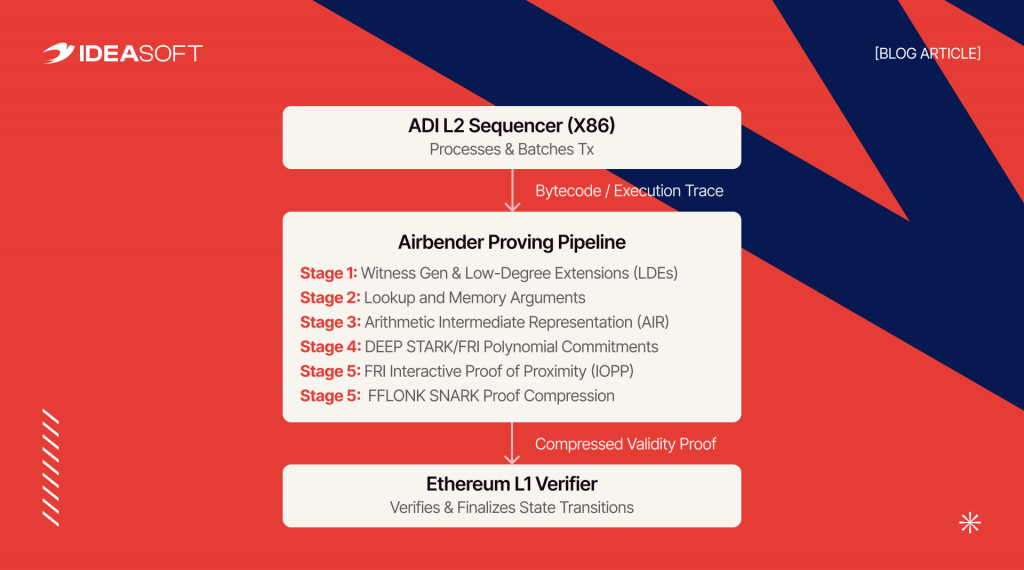
- Proving Running Mode (RISC-V Target). This target compiles to standard RISC-V 32I+M bytecode and runs inside the Airbender prover during proof generation. Because this environment lacks an operating system, it requires manual memory allocation and absolute determinism to generate valid mathematical proofs of execution.
The Airbender proving system is an execution-proving framework built on optimized STARK and FRI implementations. It compresses RISC-V execution traces into lightweight proofs verified directly on Ethereum. The pipeline processes transactions through 6 stages:
Node Infrastructure and Client Configurations
In Ethereum, a node operator must run both an Execution Client (such as Geth or Nethermind) and a Consensus Client (such as Lighthouse or Prysm) to sync, verify, and broadcast blocks. This architecture requires continuous storage of the global state trie.
ADI Chain simplifies this process for non-validating participants by offering a read-only external node configuration. This setup runs via two helper sidecars:
- external_node. Replays L2 blocks from the canonical sequencer, maintains local state, and exposes JSON-RPC endpoints for querying data.
- proof-sync. Periodically downloads pre-generated proving artifacts from Azure Blob storage directly into the local data directory.
This architecture allows external participants to run high-performance read-only nodes without the intense compute resources required to generate zero-knowledge proofs locally.
ADI Chain vs Ethereum L2: Resource Management and Accounting Models
To prevent denial-of-service attacks and price computational execution, block-space must be metered. The resource accounting models of Ethereum and ADI Chain illustrate a key divergence in execution design.
Ethereum’s Single Gas Accounting
Ethereum uses a single, unified gas metric to price all computational and storage operations. Each transaction specifies a gasLimit and a gasPrice (split into a base fee and priority tip under EIP-1559). While this model is straightforward, it struggles to differentiate between on-chain execution complexity and off-chain resource usage. This results in highly volatile gas fees when state storage or transaction throughput spikes.
ADI Chain’s Double Resource Accounting
To maintain EVM compatibility while managing the physical costs of zero-knowledge proving and data publication, ADI Chain implements a Double Resource Accounting model. The network tracks two distinct resource metrics:
- Ergs. The execution environment resource, designed to be equivalent to EVM gas. It regulates computational bounds within individual call frames and maintains EVM equivalence.
- Native Resource. This tracks the off-chain computational cycles (measured as RISC-V cycles) required to prove the transaction and publish its state changes.
To avoid using custom transaction formats, the native resource limit is derived dynamically from the transaction’s gas limit and gas price parameters.
Develop Your Next Web3 Solution on ADI Chain
We help businesses navigate ADI Chain’s technical stack
Difference Between ADI Chain and Ethereum: Bridge Infrastructure and Security Risk Vectors
The structural connection between Layer-1 and Layer-2 networks is governed by bridge contracts. The architecture of these contracts defines the security boundaries and trust assumptions of the scaling layer.
Bridging Channels and Flow Analysis
The ADI Chain Canonical Bridge routes assets between Ethereum and ADI Chain without relying on third-party multi-signatures or external oracles. Instead, it uses Ethereum smart contracts and zero-knowledge validity proofs to verify L2 state transitions.
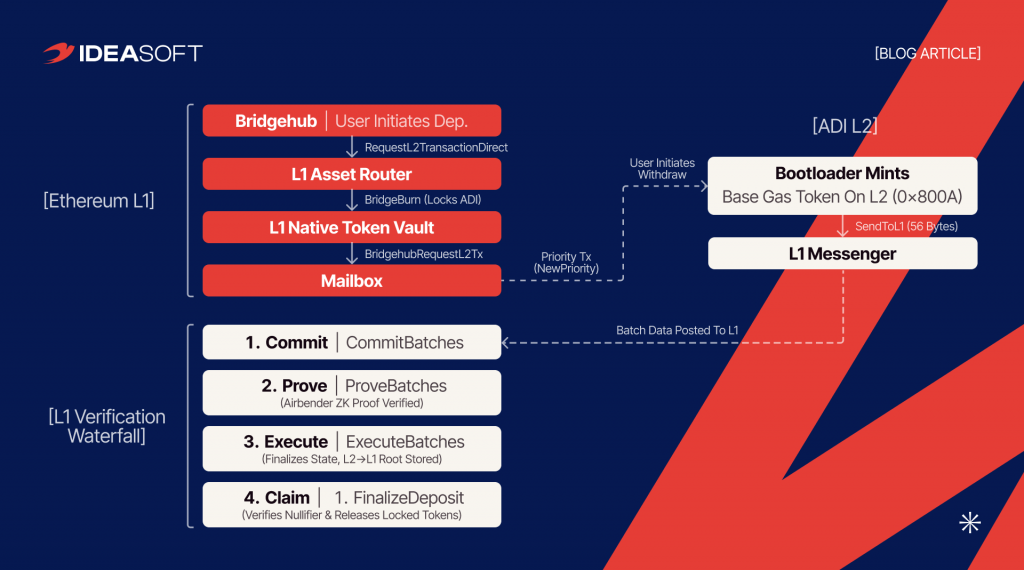
Depositing assets to ADI Chain proceeds through several key steps:
- The user authorizes the bridge by calling approve() on the ADI ERC-20 contract (0x8b1484d57abbe239bb280661377363b03c89caea) on Ethereum.
- The user initiates the deposit by calling requestL2TransactionDirect() on the L1 Bridgehub proxy contract (0x7a38c18a229ef8a0ae7104ba272a46280f2d59cb).
- The Bridgehub calls bridgehubDepositBaseToken() on the L1 Asset Router (0xf25227efad2046d19777a4ca540b5c016df7fe7a), which in turn calls bridgeBurn() on the L1 Native Token Vault (0x0a0f8912162ff83a036883dbada42eff647a3065). The vault locks the tokens via safeTransferFrom() and updates the accounting ledger: chainBalance[chainId][assetId].
- The Bridgehub calls bridgehubRequestL2Transaction() on the L1 Mailbox contract. This registers the deposit as a priority transaction and emits a NewPriorityRequest event on Ethereum.
- The ADI sequencer processes the event, and the L2 Bootloader calls mint() on the L2 Base Token system contract (0x800A), minting native gas balance to the user’s L2 address.
Standard ERC-20 tokens are routed using the two-bridge entry point requestL2TransactionTwoBridges(), which locks the gas fee in ADI and the asset in the L1 Native Token Vault, deploying a deterministic BridgedStandardERC20 contract via CREATE2 on L2 if the asset is bridged for the first time.
To withdraw assets back to L1, the user calls withdraw() on L2, burning the asset and recording a 56-byte withdrawal message in the L1 Messenger system contract (0x8008). The batch then moves through an L1 settlement sequence:
- Commit: Batch data and message roots are committed to L1 via commitBatchesSharedBridge().
- Prove: An Airbender ZK proof is verified on-chain via proveBatchesSharedBridge().
- Execute: The batch is finalized, and its Merkle root is stored in l2LogsRootHashes via executeBatchesSharedBridge().
- Claim: The user submits a Merkle proof to finalizeDeposit() on the L1 Nullifier contract (0x5e5a72077dfb354dfe61200b8f31fa491f9b9cea). The contract marks the nullifier as finalized to prevent double-claiming and instructs the Native Token Vault to release the assets to the recipient.
ADI Foundation has integrated Hypernative’s real-time monitoring and automated response platform. This integration provides active monitoring of smart contracts, bridge transactions, and admin wallets, enabling the system to automatically flag and contain threats before transactions are finalized on Ethereum.
ADI vs ETH Blockchain: Developer Ecosystem, Middleware, and Wallet Infrastructure
The usability of a blockchain depends largely on its developer tooling, deployment frameworks, and user interfaces.
Account Abstraction and Wallet Architecture
Ethereum supports ERC-4337 account abstraction as an optional, overlay framework. In contrast, ADI Chain inherits native account abstraction capabilities from the ZKsync zkOS stack, allowing developers to build smart accounts with custom verification logic and gas sponsorship out of the box.
The official non-custodial ADI Wallet uses ZeroDev’s Kernel v3.1 smart contracts. Deployed entry points on the network include:
- V0.7 EntryPoint: 0x0000000071727De22E5E9d8BAf0edAc6f37da032
- V0.8 EntryPoint: 0x4337084d9e255ff0702461cf8895ce9e3b5ff108
To support gas sponsorship, the network integrates Pimlico’s bundlers and permissionless.js client infrastructure. However, a notable developer constraint exists: at the protocol level, the RPC nodes do not fully support debug_trace in safe mode. As a result, standard bundlers that require safe mode by default cannot operate seamlessly, requiring custom node configurations or alternative bundler setups.
Enterprise Middleware and Hyperledger FireFly
To simplify integration for enterprise and public-sector developers, ADI Chain features Hyperledger FireFly as native middleware. This middleware abstracts smart contract complexity by:
- Auto-generating standard REST APIs for any compiled Solidity contract deployed on the network.
- Providing reliable, guaranteed event streaming to connect on-chain state changes with legacy databases.
- Offering direct integration gateways to external decentralized identity (DID) registries and customer KYC management systems.
This enterprise middleware simplifies web development for corporate and government IT departments accustomed to traditional RESTful architectures, contrasting with Ethereum’s reliance on custom Web3 library integrations (such as ethers.js or viem).
ADI Chain vs Ethereum: Real-World Case Studies and Stablecoin Ecosystems
The divergence between the target audiences of Ethereum and ADI Chain is reflected in their real-world applications. While Ethereum hosts a global ecosystem of retail-oriented dApps, ADI Chain focuses on localized, government-backed infrastructure and regulated stablecoins.
The UAE Dirham Stablecoin (DDSC) Landscape
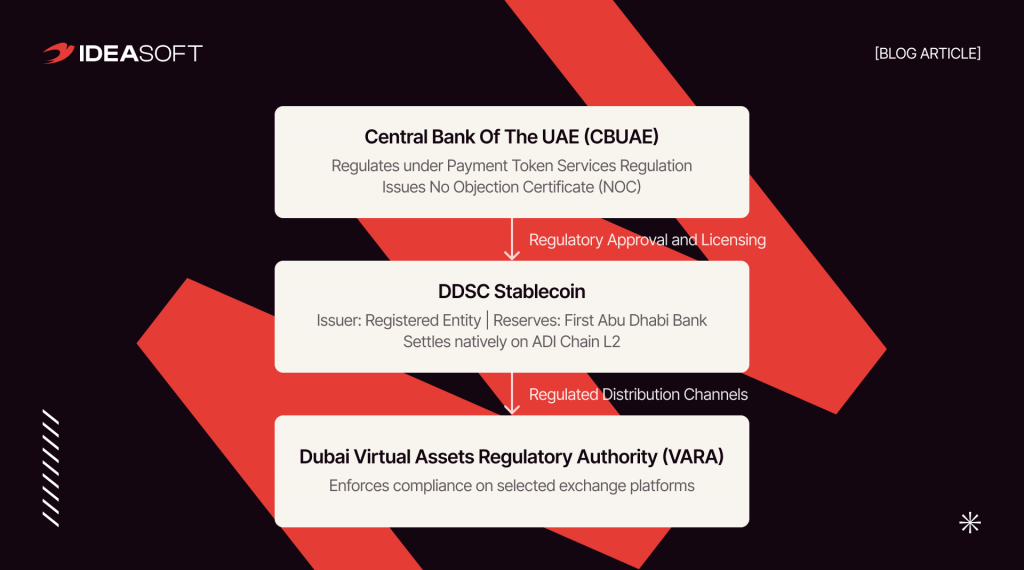
The primary application of ADI Chain’s infrastructure is the UAE Dirham Stablecoin (DDSC). DDSC is a 1:1 AED-backed stablecoin issued by a registered entity, with cash reserves held in custody by First Abu Dhabi Bank (FAB)—which secures 33% of the UAE’s banking market share.
The regulatory framework governing DDSC highlights the integration of sovereign compliance with public ledger security:
- Federal Licensing. DDSC is licensed by the Central Bank of the UAE (CBUAE) under the Payment Token Services Regulation.
- Local Exchange Distribution. In July 2026, the Central Bank of the UAE issued a No Objection Certificate (NOC) allowing DDSC to be distributed through selected crypto exchanges regulated by Dubai’s Virtual Assets Regulatory Authority (VARA). This bridges CBUAE’s federal monetary rules with VARA’s regional trading guidelines.
- Operational Volume. In May 2026, IHC processed an AED 110 million (approximately $30 million USD) transaction on ADI Chain, demonstrating the network’s readiness for high-value corporate treasury settlements.
This regulated local-currency model contrasts with the broader stablecoin landscape in the UAE, which includes various independent initiatives:
- AEDZ. A regulated, multi-chain AED-backed stablecoin issued by Zand Bank on public ledgers.
- AECoin. An approved AED-backed stablecoin issued by Al Maryah Community Bank (Mbank).
- USDU. A regulated, USD-backed stablecoin registered as a foreign payment token for domestic payment settlement.
Emerging Market Pilots and AI Agent Frameworks
Beyond the UAE, the ADI Foundation is piloting several infrastructure projects across emerging markets:
- Kenya Health Records: Partnering with medical and health-tech groups to deploy portable, cryptographically secure health records across national clinical databases.
- African Mobile Payments: Integrating with mobile money providers, including M-Pesa Africa, to explore on-chain, low-cost payment settlements for 60 million active users.
- Climate Infrastructure: Partnering with green-tech initiatives in East Africa to tokenize utility data and support carbon credit verification markets.
- FIFA World Cup 2026 Predictstreet: Launching its first consumer-facing predictive marketplace for the FIFA World Cup, utilizing Chainlink’s decentralized oracle network to resolve predictive event data.
Furthermore, ADI Chain supports autonomous trade through its Trusted AI Agent Infrastructure. Deployed via the ERC-8004 registry layer, this framework provides identity, reputation, and cryptographic validation to autonomous software agents. This infrastructure allows AI agents to verify one another and settle micro-payments using $ADI or DDSC, establishing an automated machine-to-machine economy.
Building on ADI Chain?
We help businesses build secure and scalable solutions for the ADI ecosystem.
ADI Chain vs ETH: Tokenomics and Monetary Design
The token economics of Ethereum and ADI Chain reflect their differing targets, utilities, and programmatic design features.
ETH vs. ADI: Utility and Custom Gas Models
Ethereum’s native asset, ETH, is used for security, transaction fees, and collateral. Under EIP-1559, a portion of the transaction fee is burned, introducing a deflationary mechanic during high activity.
The ADI token ($ADI) is a utility asset designed for institutional compliance networks. Its core economic utilities include:
- Native L2 Gas Fees: Using zkStack’s Custom Gas Token module, $ADI serves as the native gas asset on ADI Chain (L2) and its Layer-3 networks, removing the need for users to hold or manage ETH.
- Treasury Staking: To preserve value, ADI holders can stake tokens in a treasury-backed pool to earn rewards without diluting the token supply through programmatic minting.
The ADI token has a maximum supply of 999,999,999 $ADI. The genesis supply is configured at 999,999,999 $ADI and allocated across several buckets:
| Allocation Category | Allocation % | Genesis Token Count | Cliff Duration | Vesting Schedule / Terms |
| Community Fund | 35% | 349,999,999 | None | 72 Months (1.39% available at TGE) |
| Treasury Reserves | 25% | 249,999,999 | None | 108 Months (5.00% available at TGE) |
| Private Investors | 12% | 119,999,999 | 12 Months | 72 Months of linear unlocks |
| Partnerships | 10% | 99,999,999 | 12 Months | 72 Months of linear unlocks |
| Team | 10% | 99,999,999 | 12 Months | 72 Months of linear unlocks |
| Token Incentivization | 4% | 39,999,999 | None | 100% available at TGE |
| Liquidity | 4% | 39,999,999 | None | 100% available at TGE |
For all allocations subject to linear vesting schedules, tokens are programmatically released on the 9th of each month.
Summary on Difference Between ADI Chain and Ethereum
Comparing Ethereum and ADI Chain highlights how modular blockchain architectures can address different priorities.
Ethereum remains a secure, neutral base layer designed for permissionless execution and global consensus. However, its generalized design can create high cost barriers and lack the specialized compliance controls needed for regulated applications.
ADI Chain addresses these gaps by building a modular compliance gateway on top of Ethereum. By leveraging the ZKsync zkOS stack and the Airbender RISC-V prover, the network achieves low transaction costs and sub-second confirmations. This performance is supported by a Double Resource Accounting model that separates execution limits from physical proving costs.
Through its support for modular Layer-3 compliance domains, native ERC-4337 account abstraction, and Hyperledger FireFly integration, ADI Chain provides a clear onboarding path for enterprises and governments. Its technical feasibility is demonstrated by live deployments like the CBUAE-licensed UAE Dirham Stablecoin (DDSC).
Ready to Build on ADI Chain?
We provide blockchain development expertise to help businesses integrate ADI Chain, develop custom smart contracts, and build enterprise-ready Web3 solutions.